How Demand Charges Impact Texas Manufacturing Warehouses — and How to Decode the Commercial EFL
A warehouse can use the same total kWh as last month and still receive a higher bill if a short equipment spike pushes the billing demand higher. For Texas manufacturers, distributors, cold-storage operators, and retail facilities, the commercial Electricity Facts Label (EFL) and the delivery tariff details matter as much as the advertised energy rate.
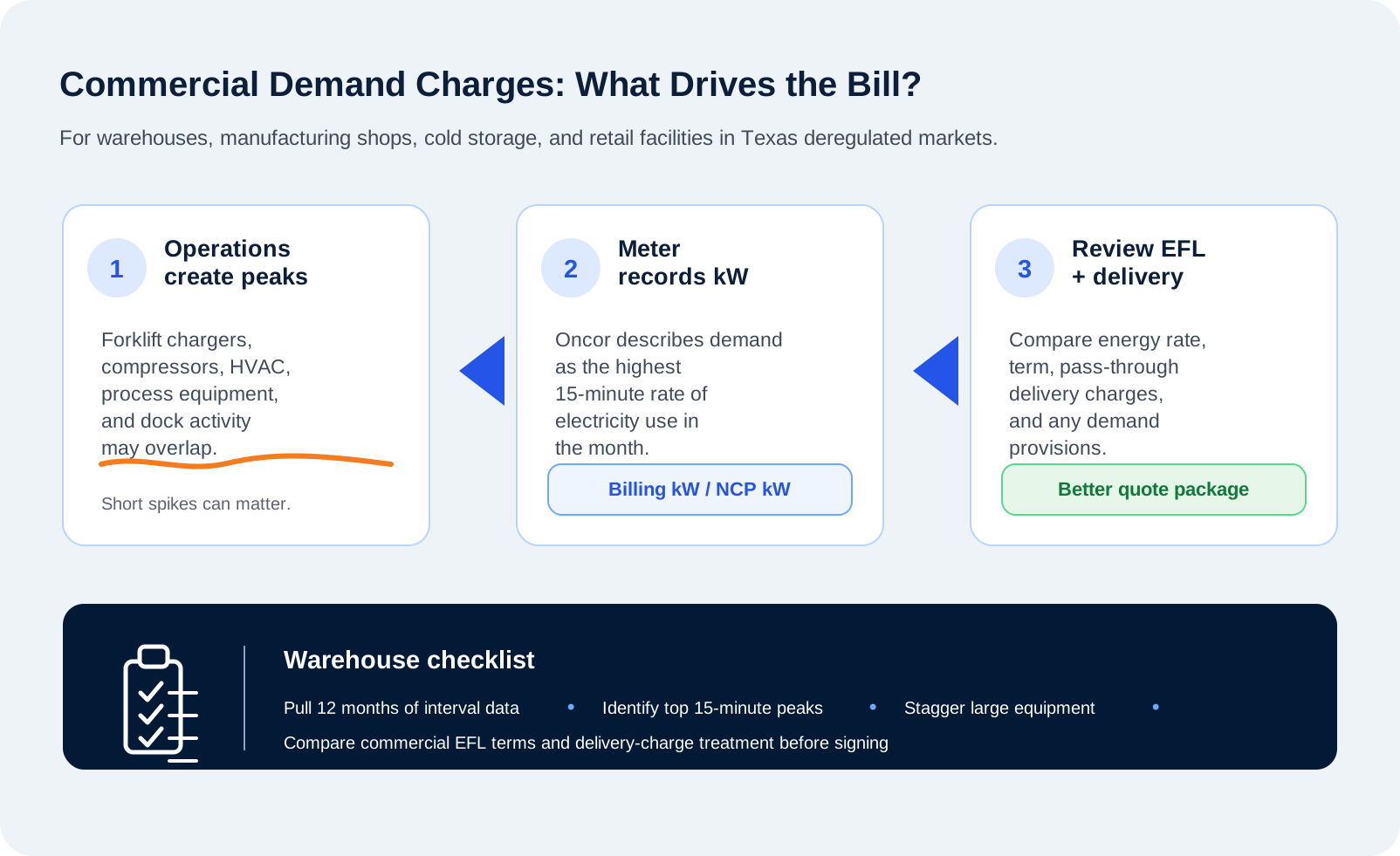
Quick overview for Texas businesses
Residential electricity shoppers usually compare plans at 500, 1,000, and 2,000 kWh. Commercial accounts are different. A Texas business may need to compare energy rate, term, usage shape, delivery charges, meter class, ESI ID, credit terms, and whether the facility is billed on demand.
In the Oncor area, Oncor explains that non-residential Secondary Service Greater Than 10 kW includes fixed monthly charges and several variable charges that may be based on Billing kW, NCP kW, 4CP kW, or kWh depending on the tariff component. That is why two warehouses with the same monthly kWh can have different bills if one has sharper peaks. Oncor’s Delivery Charges 101 also explains that demand is tied to the highest 15-minute interval recorded during the billing month.
kWh measures volume
Kilowatt-hours show how much electricity the facility consumed over time. Lighting, HVAC, motors, compressors, chargers, and production equipment all add to kWh.
kW measures peak intensity
Kilowatts show how fast the facility used electricity during a short interval. When several large loads run at once, the meter may record a higher peak even if total monthly usage stays flat.
Why manufacturing warehouses see demand spikes
Manufacturing and warehouse operations often stack electrical loads without realizing it. Shift start-up, dock-door activity, air compressors, batch equipment, conveyors, battery chargers, HVAC recovery, and refrigeration cycles can all overlap during a short window.
The issue is not always the total energy used. The issue is whether a short peak becomes the month’s billing kW. For a business trying to lower its cost, reducing one 15-minute peak can sometimes be more valuable than trimming a small amount of off-peak kWh.
- Forklift and pallet-jack chargers starting at the same time.
- Compressed air systems recovering after leaks or heavy tool use.
- HVAC units restarting after doors remain open during shipping.
- Production equipment, conveyors, pumps, or refrigeration compressors running together.
How Oncor delivery demand charges can enter the bill
Oncor’s tariff and rate schedule page explains that retail delivery rates and applicable riders are approved by the Public Utility Commission of Texas. Oncor’s delivery-charge guide separates Secondary Service Less Than or Equal to 10 kW from Secondary Service Greater Than 10 kW, and the greater-than-10-kW category can include demand-based components such as Distribution System Charge times Billing kW and Transmission Cost Recovery Factor times NCP kW or 4CP kW.
That means the business should not evaluate a commercial offer by energy rate alone. A lower cents-per-kWh energy rate may still be a poor fit if the contract language, pass-through treatment, or billing determinants do not match the way the facility actually operates.
| Billing item | What it means | Why it matters to warehouses |
|---|---|---|
| Energy charge | The REP’s cents-per-kWh supply rate or index/adder structure. | Controls the energy side of the bill, but does not fully explain demand-metered delivery costs. |
| Customer / metering charge | Monthly delivery-related fixed charges based on the rate class. | Usually predictable, but still part of the all-in cost. |
| Billing kW / NCP kW | Demand measures tied to the facility’s peak use during a defined interval. | Can jump when equipment overlaps, even if monthly kWh does not change much. |
| 4CP-related exposure | A transmission-related concept tied to ERCOT peak intervals when applicable in tariff components or commercial pricing. | Large facilities may need a strategy for summer afternoon load shape, not just total usage. |
| Taxes, fees, riders | PUCT-approved charges, local items, and pass-throughs that can change over time. | Ask whether the REP passes these through at cost and how they appear on invoices. |
Decoding the commercial Electricity Facts Label
The Public Utility Commission of Texas uses the EFL as a standardized disclosure tool, and PUCT Rule §25.475 covers information disclosures to residential and small commercial customers. The PUCT also states that each Retail Electric Provider must provide a copy of the Electricity Facts Label upon request on its Electricity Facts Label resource page.
For a small commercial business, the EFL should be treated like the front page of the deal, not the whole deal. For larger commercial accounts, the proposal, contract, pass-through language, historical usage, demand profile, and invoice format can be just as important as the EFL itself.
What to look for before signing
A commercial EFL or quote package should answer how the provider prices energy and how delivery charges are treated. If the offer is vague, ask the REP or broker to show the bill math using your actual 12-month kWh and kW history.
- Energy rate: fixed, indexed, block, heat-rate, or custom structure.
- Delivery treatment: bundled, pass-through, or separately itemized.
- Demand language: whether kW, NCP, 4CP, or ratchets affect the invoice.
- Contract term: start date, end date, renewal language, and early termination terms.
- Operational fit: whether the quote reflects a warehouse, manufacturing, cold-storage, or retail load profile.
Oncor business electricity plugin
Compare Oncor Business Electricity Rates
For warehouses, manufacturing facilities, retail stores, and multi-location businesses in the Oncor service area, The Power Choice can help package your usage, ESI IDs, and renewal dates so providers quote the right commercial product.
- Best for accounts that need business electricity pricing, not residential 500/1000/2000 kWh examples.
- Useful when your facility may be above 10 kW or has seasonal demand spikes.
- Ask for energy rate, pass-through delivery treatment, contract term, and any demand language in writing.
A practical demand-charge example
Assume a warehouse uses 80,000 kWh in a month. In Scenario A, the warehouse staggers its chargers and compressors, and the peak is 180 kW. In Scenario B, production equipment, HVAC recovery, compressors, and chargers overlap, and the peak is 260 kW.
The two accounts may have similar energy usage, but Scenario B can face higher demand-based delivery charges and may also look riskier to a REP pricing a custom commercial contract. The lesson is simple: monthly kWh tells the provider how much energy you use; interval data tells the provider how you use it.
How to reduce peak demand without hurting operations
The U.S. Department of Energy describes demand response as a voluntary, short-term reduction in usage that can be triggered by grid reliability or high market-price conditions and may produce bill credits or other compensation. Even outside a formal demand-response program, the same operational thinking can help a facility reduce avoidable spikes. DOE’s demand response overview is a useful starting point.
- Stagger forklift battery charging and avoid starting all chargers at shift change.
- Repair compressed-air leaks and sequence compressors so they do not all recover at once.
- Pre-cool or pre-heat strategically, then avoid HVAC recovery during the same window as process loads.
- Use controls, timers, VFDs, soft starts, and building automation where appropriate.
- Review 15-minute interval data from Smart Meter Texas or Oncor tools before requesting quotes.
When a broker should review the account
A broker review is most helpful when the business has multiple meters, seasonal production, a pending expansion, a refrigeration load, variable shifts, or a prior bill showing demand-based delivery charges. It is also helpful when the customer only has a renewal quote and does not know whether the proposed rate is energy-only, all-in, or pass-through.
For manufacturing warehouses in the Oncor footprint, a strong quote request should include ESI IDs, 12 months of usage, interval data when available, current contract end date, desired term, credit information, and notes about upcoming operational changes. That gives REPs a cleaner view of risk and helps avoid apples-to-oranges pricing.
FAQ
Does every Texas business pay a demand charge?
No. Smaller non-residential accounts may be on a less-than-or-equal-to-10-kW rate class, while larger facilities can fall into demand-metered classes. Review the meter class, invoice, tariff, and usage history.
Is the lowest energy rate always the best commercial plan?
No. The best plan depends on energy rate, delivery treatment, demand profile, contract term, fees, and how the REP handles pass-through charges.
What data should I gather before shopping?
Collect 12 months of bills, ESI IDs, contract dates, monthly kWh, peak kW, and interval data when available.