Last Updated: April 30, 2026
Are Solar Buyback Plans Worth It?
For many Texas solar customers, the answer has changed. A solar buyback plan can still help, but only when the export credit is large enough to beat the plan’s monthly fee, import rate, and fine print.
The quick answer
Solar buyback plans are worth it when the customer exports meaningful excess power and the retail plan is not overpriced. They are usually less attractive when the plan has a high monthly fee, a high import rate, a cap on credits, no cash-out option, or only a real-time wholesale buyback rate.
In Texas, many customers are better off comparing a solar buyback offer against a simple low fixed-rate plan from The Power Choice. The right answer is not “solar buyback or nothing.” The right answer is the plan that produces the lowest total annual electric cost after import charges, delivery charges, monthly fees, and export credits are all counted.
Buyback plan may fit
- You export a lot of daytime solar each month.
- The import energy rate is still competitive.
- The monthly fee is low enough to justify the credit.
- The credits roll over and are not heavily capped.
Low fixed rate may be better
- Your system mostly offsets your own usage.
- Your export credit is only a few cents per kWh.
- The buyback plan adds a monthly fee.
- The buyback plan charges a higher import rate.
What a solar buyback plan actually does
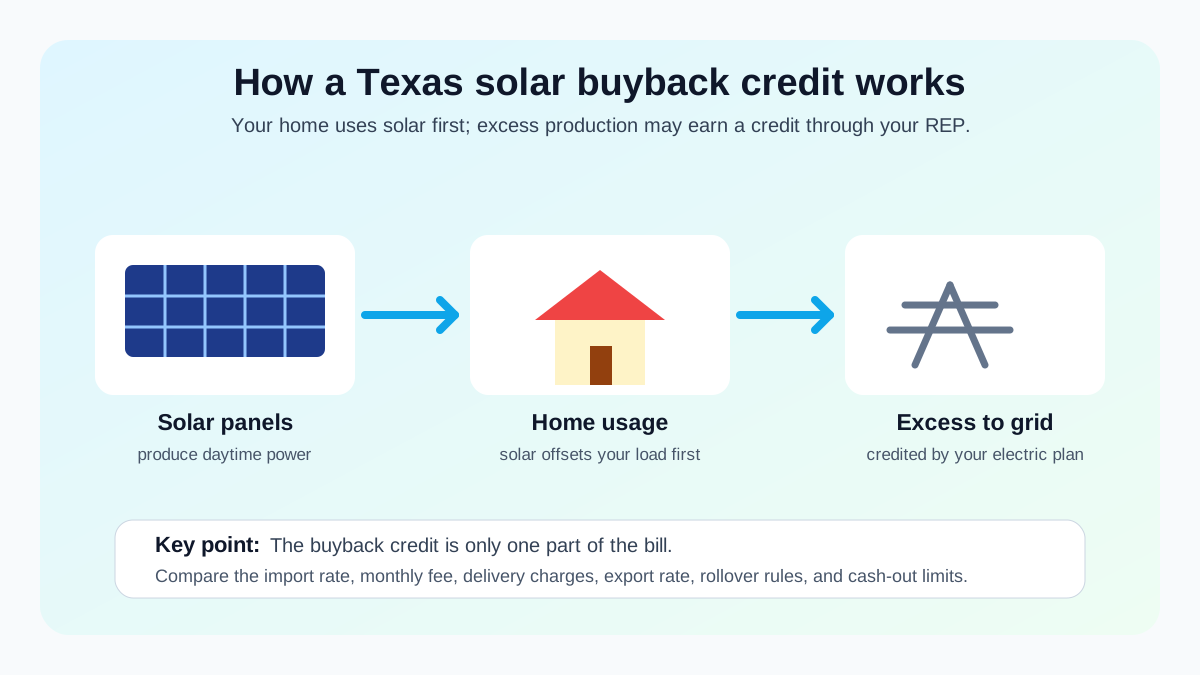
A solar buyback plan pays or credits you for electricity your panels send back to the grid. Your home uses its solar generation first; if the panels produce more power than your home is using at that moment, the excess flows through the meter and becomes an export.
In deregulated areas of Texas, the delivery company still owns the poles, wires, and meter. That includes utilities such as Oncor, CenterPoint, AEP Texas, TNMP, LP&L. The retail electric provider controls the solar buyback plan terms, so the export credit can vary widely by provider, ZIP code, usage profile, system size, and contract.
That is why Texas solar shoppers should not assume their utility is offering traditional statewide net metering. The Public Utility Commission of Texas distributed generation page explains that Texas customers have the right to on-site distributed generation, but the retail buyback credit is still controlled by the plan documents offered by the retail electric provider.
A short history: why early 1:1 buyback plans looked so good
Early solar buyback plans in Texas were often much more generous than many of the options customers see today. Some early plans effectively credited exported solar at a 1:1 retail rate, and some bundled the energy charge and delivery charge into one all-in price.
That mattered because a bundled plan could make the buyback credit look like it was paying the customer the same full price the customer paid for usage from the grid. In plain English, if the customer bought electricity at a bundled all-in rate, the provider might buy exported solar back at that same bundled all-in rate.
For the solar customer, that was powerful. For the retail electric provider, it could be expensive. Delivery charges, billing costs, credit risk, imbalance risk, and wholesale settlement costs do not disappear just because a customer exports solar during the day. As more rooftop systems were installed and more customers learned how valuable those plans were, many providers changed their offerings.
That shift is why older solar customers sometimes remember a better deal than what is available now. Some of those early 1:1 or bundled-credit structures were customer-friendly but difficult to sustain in a competitive market where providers still had to manage wholesale cost, customer load, and utility delivery charges.
What many solar buyback plans look like now
Many modern solar buyback plans have moved away from full 1:1 retail credit. Today it is common to see a separate import rate, a separate export rate, a monthly plan fee, caps on credits, limits on system size, no cash-out option, and rollover rules that only allow credits to offset future bills.
Some offers look attractive because the marketing emphasizes “solar buyback,” but the math is less attractive when the customer notices the plan has a high monthly fee or a higher energy rate than a standard fixed-rate plan. The plan’s Electricity Facts Label and Terms of Service should show whether export credits are fixed, capped, rolled over, or tied to ERCOT wholesale pricing, so the customer should compare those terms against a regular fixed-rate electricity plan before enrolling.
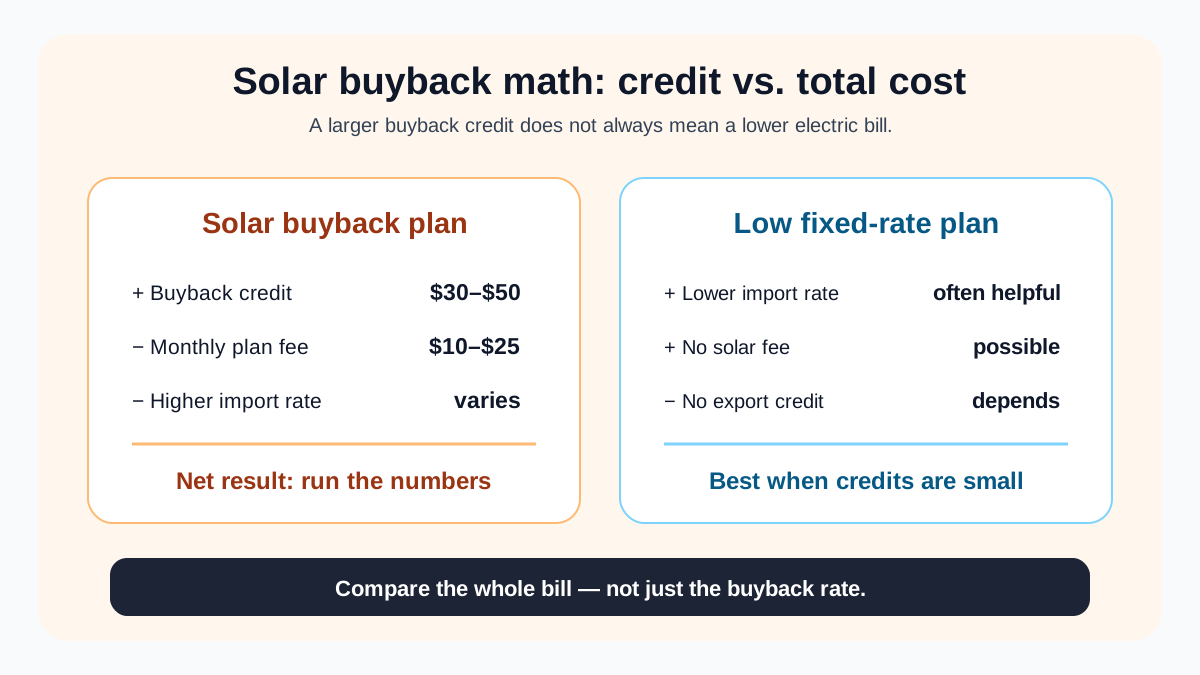
That does not mean every buyback plan is bad. It means the customer must compare the full bill. A plan that pays 3¢ per exported kWh may still be useful for a high-export household if the import rate is low and the fee is small. But if the plan charges more for every imported kWh, the customer may give back the entire solar credit through a higher usage charge.
Real-time market buyback: why the credit is often smaller than expected
A real-time market buyback plan credits exports based on wholesale prices rather than a fixed retail credit. ERCOT publishes real-time market information on its Real-Time Market page, including settlement point prices that are produced from SCED locational marginal prices every 15 minutes.
Real-time prices can spike during scarcity, but most customers should not build their household economics around occasional spikes. As a practical planning estimate, many Texas solar customers should model real-time export credits around 3¢ to 5¢ per kWh over a month unless their provider’s historical statements show otherwise.
Here is the simple math: 1,000 kWh exported at 3¢ per kWh is a $30 credit. The same 1,000 kWh exported at 5¢ per kWh is a $50 credit. That is why many customers on real-time buyback rates may only see roughly $30 to $50 of monthly export value, especially after cloudy days, seasonal production changes, and self-consumption reduce the amount actually exported.
| Monthly export example | RTM credit at 3¢/kWh | RTM credit at 5¢/kWh | Why it matters |
|---|---|---|---|
| 500 kWh exported | $15 | $25 | A monthly fee can wipe out the credit. |
| 1,000 kWh exported | $30 | $50 | Common planning range for many solar homes. |
| 1,500 kWh exported | $45 | $75 | Helpful only if import rate and fees stay competitive. |
Why the solar industry is under pressure
The economics of residential solar changed sharply when the federal incentive picture changed. The IRS says the Residential Clean Energy Credit equaled 30% of qualified costs for systems installed from 2022 through December 31, 2025, but the credit is not available for property placed in service after December 31, 2025. You can read that directly on the IRS Residential Clean Energy Credit page.
That loss matters because the tax credit helped support residential solar sales for years. Reuters reported in February 2026 that U.S. rooftop solar companies were preparing for a steep drop in business after the expiration of the homeowner tax credit, with layoffs, restructurings, and company failures already affecting the sector. The SEIA Solar Market Insight reports also show how tax-credit deadlines and policy changes have affected solar market forecasts.
This pressure can affect customers after installation. If the company that sold or installed the system disappears, the homeowner may still have panels, a loan, and equipment warranties, but getting workmanship repairs, monitoring support, roof leak help, inverter troubleshooting, or production issues fixed can become harder. Reuters reported on Sunnova’s Chapter 11 filing, and industry warranty sources such as SolarInsure have tracked numerous solar contractor closures.
The loan and lease problem: why some customers regret the deal
Solar can be a good investment when the system is priced correctly, installed well, financed responsibly, and matched to the customer’s usage. The problem is that many customers were sold solar through long-term loans, leases, or power purchase agreements that were presented as “bill replacement” instead of debt or a long-term payment obligation.
The CFPB warned consumers about costly and complex solar loans, noting that dealer fees can inflate the amount borrowed and make the interest rate look lower than the real economics. The FTC also advises customers to understand whether they are buying, leasing, or signing a power purchase agreement, and to ask how solar may affect selling the home; see the FTC’s Solar Power for Your Home guide.
Texas has seen enough customer complaints that lawmakers moved toward more regulation of residential solar sales. The San Antonio Express-News reported on a proposed Texas residential solar retailer law aimed at misleading claims, hidden costs, and poorly explained financing in its article on Texas solar sales regulation. The FTC has separately warned businesses not to make misleading solar financing claims in its post, Don’t waste your energy on a solar scam.
For customers already locked into a 20-year or 25-year loan or lease, the buyback plan alone usually will not solve the economics. Many customers will not realize the savings they expected until the loan or lease is paid down, and some may never reach the promised savings if the system underproduces, the roof needs work, the inverter fails, or the buyback credit is much lower than the sales presentation assumed.
When a low fixed energy rate may beat a solar buyback plan
A low fixed-rate electricity plan with no monthly solar fee may be better when the solar system mostly serves the home instead of exporting large amounts to the grid. That is especially true for homes with batteries, high daytime usage, electric vehicles that charge during solar hours, or smart thermostats that pre-cool the home while the panels are producing.
The reason is simple: avoided usage is usually more valuable than exported usage. If your panel production offsets a kWh you would have bought from the grid, you may avoid the full energy charge and delivery charge for that kWh. If you export that same kWh on a real-time buyback plan, you may only receive a few cents.
That is why the best strategy is often to reduce imports first, then compare what happens to the leftover exports. A customer who exports very little does not need to overpay for a buyback feature. A customer who exports a lot should shop buyback plans carefully and compare them against the best non-solar fixed offers available at the same address.
A practical checklist before choosing a plan
Before enrolling in a solar buyback plan, review the Electricity Facts Label, Terms of Service, and Your Rights as a Customer documents. Pay attention to these items:
- Import rate: What do you pay for every kWh you buy from the grid?
- Monthly fee: Is there a solar fee, base charge, membership charge, or minimum usage requirement?
- Delivery charges: Are delivery charges separate, bundled, or excluded from the credit calculation?
- Export rate: Is it fixed, real-time market, capped, or matched to your retail energy rate?
- Credit rules: Do credits roll over, expire, or disappear when you switch providers?
- Cash-out: Can you receive a check, or are credits only usable against future bills?
- System size limits: Does the plan limit oversized systems or net exporters?
- Contract risk: Does the provider reserve the right to change solar terms after the contract?
Bottom line
Solar buyback plans are not automatically worth it anymore. The early Texas solar market had generous 1:1 and bundled-credit plans that made solar exports very valuable. Today, many offers use lower fixed credits, real-time market credits, higher monthly fees, higher import rates, and tighter rules.
For a Texas homeowner, the best decision is to compare the whole bill. If the buyback plan produces more annual value than the added fee and higher import cost, it can be worth it. If the credit is only $30 to $50 per month while the plan adds a monthly fee and a higher energy rate, a low fixed-rate plan with no solar fee may be the smarter choice.
The Power Choice can help customers compare both sides: solar buyback offers and standard fixed-rate plans. The goal is not to chase the best-sounding buyback rate; it is to find the lowest realistic annual electric cost for the home.
FAQ
Are 1:1 solar buyback plans still common in Texas?
No. Some limited retail-match structures may exist, but many providers now use fixed export rates, real-time market rates, caps, fees, or rollover restrictions.
Is real-time market buyback bad?
Not always. It can work if the plan has a low import rate and low fees, but customers should model normal monthly averages instead of assuming rare price spikes.
Should I choose solar buyback if I have batteries?
Not automatically. Batteries often make self-consumption more valuable, so a low fixed-rate plan may beat a high-fee buyback plan.